July 25, 2025
Commercial Asphalt Repair
Commercial Asphalt Repair In East Central Florida
Commercial asphalt usually does not “suddenly” fail. It breaks down into patterns that repeat until the pavement structure finally gives in. Small cracks begin to hold water, turning tires grind the edges, low spots stay wet after storms, and potholes form where traffic hits the same weak area all day. If you only treat the surface symptom, the underlying weakness keeps growing, which is why many commercial lots end up repairing the exact locations again and again.
Surface King provides commercial asphalt repair for Orlando and the surrounding areas, serving East Central Florida and many East Florida markets. The goal is not the most considerable scope or the most disruptive. The goal is to identify what is failing, match the repair method to the failure, and stage the work so your site stays functional while the pavement gets back to a safer, stronger condition. For a broad overview of repair services, you can start here: Asphalt Repairs.
What Commercial Asphalt Repair Means For Property Managers
Commercial asphalt repair is corrective work that restores safety and structural performance where the pavement is actively failing. That is different from maintenance, which protects pavement that is still structurally sound, and from resurfacing, which renews a larger portion of the lot when the surface is worn across vast areas. Most commercial properties need all three over time, but the sequence matters. If structural failures are not corrected before surface treatments, the same problems often reappear quickly.
The best repair plan is the one that reduces repeat calls and emergency fixes. That means identifying whether the failure is superficial, localized, or structural, then choosing a method that solves the actual problem. A clean-looking patch that fails again in a short window is not a savings. It is a delay that often costs more once water and traffic have more time to damage the base.
Why Commercial Asphalt Fails Faster In Florida
In the Orlando market and across East Central Florida, water and heat are constant stressors. Heat accelerates oxidation, making asphalt more brittle and more prone to cracking, especially in older lots that have gone too long without protection. Heavy rain then exploits those cracks, carrying moisture down into the base and subgrade. Once the support layers stay wet, they lose strength, and the pavement begins to flex under loads.
Commercial sites also experience stresses that residential pavement rarely sees. Trucks, delivery vans, and repeated turning movements concentrate forces in the same areas every day. Entrances, drive aisles, dumpster pads, loading zones, and pavement edges take the worst of it. When those high-stress areas begin to fail, the repair approach must be designed for commercial traffic, not a light-duty patch destined to break apart again.
Warning Signs Your Parking Lot Needs Repair
A commercial lot usually gives you signs before it becomes an urgent hazard. Cracks that open up and hold water are not just cosmetic. They are active entry points for moisture that weakens the layers below. Potholes forming in wheel paths often signal base weakness under repeated loading. Depressions and ponding areas indicate drainage or settlement problems that can recur unless the underlying conditions are corrected.
If the same pothole comes back, or the same section crumbles after multiple “quick fixes,” that is often a scope problem rather than a mystery. The repair method is not reaching the absolute failure. A better plan identifies the cause, repairs the section to the correct depth, and then protects the surrounding pavement so the repair is not surrounded by deteriorating asphalt.
Crack Sealing And Crack Repair For Commercial Lots
Cracks matter because they act like channels. Water enters through cracks, sits in the pavement structure, and weakens the base. Over time, that leads to spreading cracking, breakup, and potholes that look like they came out of nowhere. Crack sealing is most effective when the surrounding pavement is still stable, and the cracking has not progressed into widespread structural patterns. Done at the right time, it slows crack growth, reduces moisture intrusion, and supports a longer maintenance cycle.
Crack sealing is not a cure for structural failure. When cracking is concentrated in wheel paths, when you see interconnected patterns, or when the pavement is breaking apart around the cracks, sealing alone typically cannot stop the decline. In those areas, the correct sequence is often structural repair first, then crack management and surface protection for the surrounding pavement.
Pothole Repair That Holds Up Under Commercial Traffic
Potholes are a safety issue, a liability issue, and a fast way to collect tenant complaints. They usually form when moisture and traffic exploit a weak spot until the surface collapses and the base loosens. A repair that holds up depends on proper removal of failed material, clean edges, correct depth, and compaction that restores the section as part of the pavement structure. If the patch is not built into stable material and appropriately compacted, traffic will begin to tear at the seam, and the pothole will return.
The key decision is whether the pothole is truly isolated. If the surrounding asphalt is solid, a properly executed patch can perform well and blend into a broader maintenance plan. If the area around the pothole is cracked, soft, or breaking apart, the pothole is often a symptom of deeper failure. In that situation, the repair method should step up so you are not paying to fix the same spot again next quarter.
Full-Depth Repair For Structural Failure
When you see alligator cracking, repeated potholes at the same location, or pavement that has clearly lost its load-bearing capacity, a full-depth repair is often the most cost-effective option over time. This method removes the failed asphalt down to a stable layer, rebuilds the base as needed, and replaces the asphalt so the section can again handle commercial loads. It is the step that breaks the patch-fail-patch cycle.
Full-depth repairs are common at loading docks, delivery lanes, and dumpster enclosures, where heavy loads and turning forces concentrate. They are also common where trenching or utility work has settled over time. If failures follow a corridor or appear along a prior cut line, subsurface conditions may be part of the fix, not just the surface. When underground work is part of the picture, this page may be relevant: Commercial Underground Utility Installation & Repair.
When Milling And Resurfacing Makes More Sense
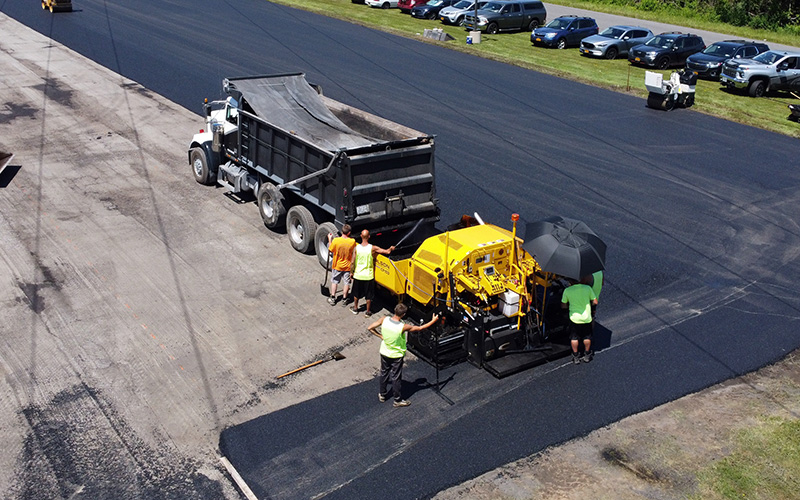
Sometimes, a lot is past the point where scattered repairs will restore dependable performance. If raveling, cracking, and rough ride quality are widespread across central drive aisles, you may get better value from a combined approach. Many commercial properties repair weak areas first, then mill and resurface, or apply an overlay, so the new surface is placed on stable pavement.
Resurfacing is not a shortcut around structural problems. If unstable areas are not corrected first, the new surface can reflect those failures sooner than expected, especially where water is still entering the pavement structure. The strongest results typically come from stabilizing problem zones, correcting drainage where needed, and then renewing the surface so you get a long life from the new layer. Learn more here: Asphalt Milling and Asphalt Resurfacing.
Drainage And Settlement Problems That Cause Repeat Repairs
In Orlando and across East Central Florida, drainage is often the hidden driver behind recurring asphalt failures. Ponding water keeps pavement saturated, softens supporting layers, and increases the odds that potholes and cracking return. If a low spot holds water after every storm, repairs in that area are likely to be needed again unless the drainage condition is addressed as part of the scope. In many cases, the proper fix combines section repair with grade correction so that water moves off the pavement rather than soaking into it.
Settlement also matters, especially near pavement edges and utility corridors. If the subgrade or base compaction is not holding, the surface will telegraph that movement through depressions and cracking. Addressing water flow and settlement is often what separates a repair that lasts from a repair that simply looks better for a short time.
Phasing Repairs To Keep Tenants And Customers Moving
Most commercial sites cannot shut down to fix pavement. Repairs need to be staged so access stays open, deliveries can continue, and pedestrian routes remain safe. A good phasing plan starts with the highest-risk zones, such as entrances, main drive aisles, accessible routes, and primary crosswalks. From there, work is grouped into sections that can be completed and reopened cleanly, rather than scattering repairs across the site and disrupting traffic everywhere at once.
Phasing also protects finish quality. When crews can focus on one area at a time, prep, compaction, and transitions are easier to control. That typically produces cleaner edges, smoother tie-ins, and a site that feels managed rather than chaotic throughout the project.
After Repairs, Protect The Surface And Restore Markings
Once structural issues are corrected, many properties benefit from surface protection and fresh markings. Sealcoating can help slow oxidation, improve appearance, and reduce water penetration when the pavement is in good condition. It is not a cure for structural failure, but it is a strong next step after structural repairs are complete because it helps the rest of the lot age more evenly.
Striping restores traffic flow, clarifies stall locations, and enhances pedestrian safety. It also reduces confusion in busy lots where deliveries, customer traffic, and employee parking overlap. If your restriping or reconfiguration includes accessible spaces and routes, it is also the right time to confirm that markings and layouts are handled correctly. Related services include Seal Coating, Line Striping, and ADA Handicap Specialists.
Why Commercial Clients Choose Surface King
Commercial clients typically want three things from asphalt repair: clear scope, reliable scheduling, and results that reduce repeat failures. Surface King focuses on matching the repair method to the problem, then completing work in a way that keeps your property usable and presentable. That includes practical staging, clean transitions, and repair decisions that prioritize long-term performance instead of temporary cosmetics.
If you manage multiple properties, consistency matters just as much as quality. Having a contractor that can evaluate conditions, explain options, and build a practical repair plan helps you budget with more confidence. It reduces the number of surprise repairs that interrupt operations.
Learn more about the company here: Surface King.
Request A Commercial Asphalt Repair Estimate In Orlando
If your parking lot has potholes, spreading cracks, ponding water, or areas that keep failing despite prior repairs, a site evaluation can usually identify whether you need targeted patching, full-depth repair, or a resurfacing plan. Surface King supports commercial asphalt repair throughout Orlando and surrounding areas, with service coverage that includes East Central Florida and many East Florida markets.
To schedule an on-site estimate, start here: Contact.

Address
Surface King, LLC
8803 Futures Dr., Suite 2
Orlando, FL 32819-9076
Phone & Fax
Phone: (407) 855-5959
Fax: (888) 389-8173
Office Hours
Weekday: 8 AM – 6 PM
Weekends: By Appointment